





The AI Readiness Imperative
Modernization is entering a new phase of clarity and acceleration.
Modernization efforts often stall due to a lack of upfront clarity. Applications are poorly documented, technical debt remains hidden, and pathway decisions are driven more by intuition than rigorous analysis. The result is increased risk, cost overruns, and mounting transformation fatigue.
The 2025–2026 period has ushered in a new level of urgency. Board-level focus on production-scale AI adoption, including LLM integration and agentic workflows, is now widespread. Modern architectures are emerging as a key enabler, allowing organizations to fully capture this opportunity. At the same time, many enterprises remain constrained by legacy environments built on monolithic codebases, tightly coupled dependencies, and outdated frameworks. As a result, CIOs are increasingly confronted with a fundamental question: are their current technology foundations ready to support AI at scale?
As a result, modernization must evolve from ad hoc upgrades to structured, AI-assisted, rule-driven transformation with embedded governance. Enterprises that successfully make this transition will leapfrog into AI-powered operations, while those that delay risk being excluded from the next wave of agentic AI adoption.
What Enterprises Should Demand
Modern modernization requires a robust set of capabilities:
- Quantified assessment. Deterministic analysis of technical debt, risk, and compliance exposure.
- Business-impact prioritization. Pathways selected based on lifecycle value and ROI, not technical urgency or engineering preference.
- Automation with human governance. AI-powered transformation with structured checkpoints to control risk and ensure quality.
- End-to-end transformation. Code, database, UI, and testing delivered as an integrated journey avoiding integration debt created by fragmented projects.
- Validation and rollback at every stage. Business continuity protected through automated testing, progressive deployment, and instant rollback.
- Feature enhancement during transformation. Adding new capabilities while transforming legacy applications.
- Continuous modernization capability. Ongoing assessment and evolution embedded in the development lifecycle without program-scale disruption.
These capabilities define modernization programs that deliver predictable, high-quality outcomes.
Two Integrated Capabilities of a Best-in-Class Modernization Platform
1. AI-Powered Intelligence
Modernization benefits from the combination of deterministic rules and adaptive AI.
Rules provide governance and proven patterns. AI agents bring flexibility, scale, and speed. Together, they enable accurate assessment and confident transformation decisions.
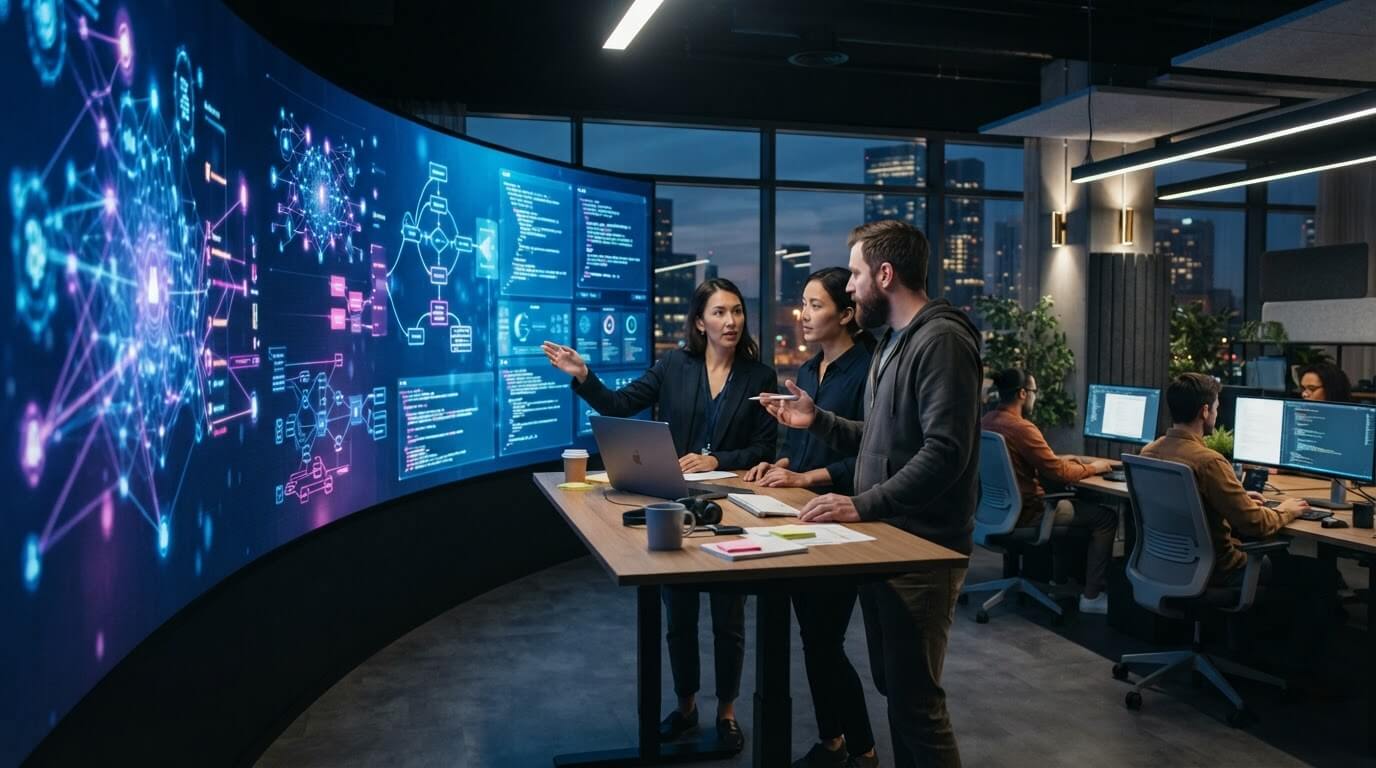
Key features of an AI-powered intelligent platform include:
- Seamless flow from assessment to execution
- Multiple transformation pathways with confidence-based recommendations
- Database modernization enabling cloud-native architecture
- Platform and language upgrades supporting cross-platform deployment
- Coordinated transformation across application and database layers
2. Rapid Transformation Approach
Speed without quality leads to recklessness, while quality without speed results in obsolescence. Leading transformation approaches should deliver both by combining speed and rigor through integrated capabilities such as:
- Code transformation: The approach should enable automated code transformation with built-in validation to ensure accuracy at scale. It should support progressive deployment with automated rollback to reduce risk, while providing real-time quality metrics and governance dashboards for continuous oversight. Parallel transformation streams should accelerate timelines without compromising enterprise control.
- AI-powered testing: Testing should be embedded across the transformation lifecycle, with automated test case generation based on code and business logic. The approach should support end-to-end and regression testing to ensure functional parity, along with performance testing to validate that modern architecture meet or exceed legacy baselines.
- Integrated UI Transformation. The approach should modernize legacy interfaces into frameworks such as Angular, React, and Vue, while incorporating responsive design and accessibility compliance by default. This ensures a consistent and high-quality user experience across modernized portfolios.
- Spec-Driven Feature Enhancement. The approach should incorporate specification-driven development to capture business requirements during transformation. This enables feature parity while supporting targeted enhancements, creating a seamless bridge between modernization and ongoing innovation.
Code, database, UI, testing, and feature enhancement delivered through a unified platform enable true end-to-end transformation, avoiding the fragmentation that often leads to partial modernization and integration challenges. By connecting assessment insights, operational intelligence, and data readiness within a single ecosystem, applications can be modernized to be operationally optimized, cost-efficient, fully tested, and AI-ready from day one
Partner Evaluation Framework
When evaluating modernization partners, enterprises should seek clarity across a few critical dimensions:
- Multi-cloud portability: Can modernized applications run seamlessly across AWS, Azure, and GCP without architectural lock-in?
- Governance and rollback: If transformation introduces unexpected issues, is there the ability to roll back instantly, or are teams forced into forward-only fixes?
- Security model transparency: How are credentials managed, how is code access controlled, and what audit mechanisms are in place?
- AI model flexibility: Is the approach tied to a single LLM provider, or does it allow the use of best-fit models across different use cases?
- End-to-end capability: Can the partner deliver across code, database, UI, and testing in an integrated manner, or will enterprises need to orchestrate multiple vendors?
These considerations help determine whether a partner enables long-term strategic flexibility or introduces new forms of dependency.
Conclusion: Modernization as a strategic advantage
The gap between modernized and legacy application estates is becoming a source of competitive differentiation.
Modern architectures enable AI adoption at scale, support agentic workflows, and provide the scalability required for real-time, data-driven operations. Enterprises advancing modernization today are positioning themselves to lead in this next phase of AI.
Piecemeal modernization approaches often introduce new technical debt by addressing isolated components without a holistic view.
An ideal modernization platform overcomes this through autonomous, AI-driven capabilities spanning code transformation, testing, and planning. It enables faster, more reliable transformation with built-in governance and quality controls, while continuously enhancing applications through intelligent feature recommendations and adaptive user experiences.
The path forward is clear. Enterprises that act decisively, with integrated and forward-looking modernization strategies, will define the next generation of industry leaders.

Modernization as a Strategic Advantage
The gap between modernized and legacy application estates is becoming a source of competitive differentiation.

Modernizing?
AI-powered code transformation, automated testing, integrated UI modernization, and spec-driven feature enhancement — delivered as a unified journey.
Explore CONCIERTO MODERNIZE
Starting with Migration?
Build the right foundation first. Engineered migration programs that deliver cloud-ready workloads and automated Day-2 operations from cutover.
Explore CONCIERTO MIGRATE
Trianz is an advanced cloud consulting partner with deep expertise in AI-powered application modernization. Our team helps enterprises move from ad hoc upgrades to structured, governed transformation programs — delivering applications that are cloud-native, fully tested, and AI-ready from day one.
Experience the Trianz Difference
Trianz enables digital transformations through effective strategies and excellence in execution. Collaborating with business and technology leaders, we help formulate and execute operational strategies to achieve intended business outcomes by bringing the best of consulting, technology expertise, and execution models.
Powered by knowledge, research, and perspectives, we enable clients to transform their business ecosystems and achieve superior performance by leveraging infrastructure, cloud, analytics, digital, and cybersecurity paradigms. Reach out to get in touch or learn more.