Meet us at AWS Summits 2026 Book a Meeting






The AI-Powered Services as Software Revolution
CONCIERTO—the unified transformation platform delivering speed, certainty, and multi-cloud freedom through AI-powered automation

Digital Transformation Outcomes are Binary,
You Win or You Fade Away
Only 7% of enterprises become Digital Champions. The remaining 93% face accelerating competitive disadvantage. There is no middle ground.

Understanding the
Digital Faultline
A fundamental discontinuity between traditional and digital business environments—each with different competitive dynamics, timescales, and value creation models
The research that changed everything
Global study analyzing 1.8 million data points across 5000+ enterprises to understand what separates breakthrough performance from failure
Data Points
Analyzed across five critical dimensions
Global Executives
CIOs, CTOs, CDOs, and business leaders
Industries
Financial Services, Healthcare, Manufacturing, and more
The binary outcome discovery
Digital transformation isn't a spectrum—it's binary. Organizations either achieve breakthrough performance or face structural decline. There is no middle ground.
DIGITAL CHAMPIONS (7%)
- 100% use data & AI across company vision
- 92% align transformation to business strategy
- 94% drive operational decisions with data
- Start with reimagined value propositions
Results Achieved:
- Major revenue boost
- Substantial customer retention increase
- Significant productivity gains
- Market leadership through continuous innovation
THE REMAINING 93%
- Traditional value rapidly commoditized
- Customer exodus accelerates
- Technology advantages impossible to recover
- Strategic irreversibility sets in
Facing:
- Multi-year competitive decline
- Massive industry disruption
- Loss of customer trust and market share
- Recovery impossible in compressed cycles
Understanding the digital faultline
A fundamental discontinuity between traditional and digital business environments
Traditional Business Environment
- Competitive advantages measured in years
- Predictable change cycles
- Scale and efficiency drive profitability
- Technology supports existing processes
- Switching costs retain customers
Digital Business Environment
- Competitive advantages measured in months
- Continuous multi-directional disruption
- Data and intelligence create compounding advantages
- Technology enables new value propositions
- Continuous value creation retains customers
Why it's a faultline, not a spectrum
Velocity
Change accelerates beyond organizational adaptation capacity. Market windows close faster than traditional transformation timelines.
Multi-Dimensionality
Disruption arrives simultaneously across technology, customer behavior, competitive dynamics, regulation, and talent markets.
Irreversibility
Advantages compound for leaders. Gaps widen exponentially. Recovery becomes mathematically impossible within compressed competitive cycles.
Binary Nature
Organizations cannot operate partially on both sides. Hybrid approaches deliver neither traditional efficiencies nor digital advantages.
The Implication
93% of enterprises struggle because they're competing in a digital environment using organizational models, decision processes, and delivery approaches designed for the traditional environment.
Digital champions—the 7% who win
Five consistent patterns separate Digital Champions from the 93% who fail
Customer Centricity
- Every decision evaluated through customer impact lens
- Technology justified by customer satisfaction & retention
- Customer needs drive priorities—efficiency follows value
Data-Driven Value Propositions
- Data informs strategy before technology deployment
- Value propositions reconceived using data as strategic asset
- Analytics identify customers, products, and markets
Speed Over Perfection
- Cost of delay exceeds cost of imperfection
- Deploy minimum viable products for real feedback
- Execution velocity trumps planning perfection
Unified Strategic Alignment
- Every initiative ties directly to measurable business outcomes
- CEO and board actively sponsor transformation
- Business and technology operate as unified teams
- No organizational silos or misaligned incentives
Outcomes Not Just Efforts
- Success measured by revenue, cost, retention, market share
- Clear metrics established before starting initiatives
- Projects killed if outcomes don't materialize
- Business impact counts—launches don't equal success
The Critical Difference
Winners didn't have better technology, more budget, or smarter people. They approached transformation differently—with customer-centric mindsets, data-driven strategies, bias toward speed, unified organizational alignment, and relentless focus on measurable business outcomes.
Five forces paralyzing enterprise transformation
Converging challenges making traditional transformation approaches structurally inadequate
Compressed Competitive Windows
The Compression:
- Product lifecycles: 10 years → 18 months
- Market disruption cycles: 5-7 years → 6-12 months
- First-mover advantage: 3-5 years → 4-6 months
AI-Powered Multi-Dimensional Disruption
Simultaneous disruption across:
- Customer expectations (personalization, real-time intelligence)
- Competitive dynamics (automated optimization, intelligent products)
- Operational models (autonomous processes, predictive analytics)
- Talent requirements (AI-augmented roles, new skill demands)
Digital-Ready Talent Scarcity
The Challenge:
- Demand for technology/data talent: Exponential growth
- Available talent supply: Linear growth
- Time to develop deep expertise: 3-5 years minimum
- Market competition for AI/cloud/data skills: Intensifying
Fragmented Technology Stack Economics
Most enterprises use 15-30 separate tools:
- Assessment and discovery platforms
- Migration execution tools
- Application modernization frameworks
- Security and compliance systems
- Multi-cloud operations management
- FinOps and cost optimization platforms
Economic Impact:
- 40-50% of budgets consumed by custom integration
- Redundant discovery and assessment across tools
- Intelligence silos preventing enterprise optimization
- Cross-tool coordination overhead delaying timelines
The Tussle Between Financial & Transformational ROI
The Strategic Disconnect:
- Boards measure transformation through traditional financial metrics—immediate cost savings, payback periods, and short-term ROI
- True transformation delivers business change—agility, competitive positioning, innovation velocity, and market responsiveness
- The longer companies remain trapped in purely financial evaluation frameworks, the more they delay essential business transformation
- While competitors transform their business models, laggards remain stuck justifying transformation investments with spreadsheet logic
Traditional Consulting's Fatal Flaw:
Traditional consulting offers zero contractual accountability for business outcomes, cost unpredictability through scope expansion, and no recourse when transformation fails to materialize.
The Cost of This Tussle:
Companies that cannot bridge financial accountability with transformational outcomes face a devastating choice: delay essential transformation while competitors advance, or proceed with initiatives that boards view as high-risk, low-accountability bets.
The Convergence Effect
These five forces don't operate independently—they converge and amplify each other. Traditional consulting and point solutions cannot address the structural challenges enterprises face. Business leaders need delivery models that align vendor incentives with enterprise success.
Revolutionaizing transformations with the
"Services as Software" model
We didn't just identify why 93% of transformations fail—we revolutionized transformation itself, creating an entirely new delivery model that replaces labor-intensive consulting with AI-powered platform led delivery. We have woven transformation processes in data, applications and infrastructure modernization and migrations into end to end AI powered solutions.
What is Services as Software?
Services as Software infuses decades of transformation experience into an intelligent platform—delivering hypersonic transformations impossible with traditional consulting and manual efforts.
Four Revolutionary Pillars:
Decades of Experience Distilled
3,000+ projects across 15 industries encoded into platform intelligence—proven patterns and best practices available instantly
Data Driven Insights Leveraged
1.8M research datapoints and 100+ live engagements continuously informing AI-powered recommendations
Tech Layers Unified
Applications, Data, and Infrastructure transformed simultaneously from a single platform—multi-cloud and vendor-neutral
Customers Empowered
Zero-code interfaces in 17 languages enable business users to drive transformation—intelligence stays with the customer, not consultants
Customer Impact
Traditional 18-24 month projects completed in 7-10 months—capturing competitive windows manual consulting misses
Fixed-scope pricing with deployment guarantees eliminates the 40-60% overruns typical of traditional consulting
Platform automation delivers enterprise transformation at a fraction of traditional consulting, internal and software costs
Vendor-neutral platform with no revenue bias—optimize across AWS, Azure, and Google Cloud without lock-in
Zero-code platform improves learning and knowledge in your teams—capability stays and compounds, unlike consulting that walks away
Platform learns from 100+ global engagements—every customer benefits from intelligence gathered worldwide
7 Operating Principles of Concierto Services as Software
The AI-Powered Services as Software model operates on seven principles addressing structural challenges
Business Empowerment Over IT Dependency
Consulting creates permanent IT dependency. Business units cannot operate independently post-engagement.
Solution: Zero-code interfaces in 17 languages enable business leaders and their teams to control transformation. Platform builds organizational capability, not vendor dependency.
Outcome: Business unit autonomy, strategic agility, ability to iterate based on market feedback without technical bottlenecks.
Business Strategy Drives Technology Decisions
Technology-first approaches deploy capabilities hoping for business value. Most fail to demonstrate measurable impact on business KPIs.
Solution: Begin by reimagining business value propositions with data as strategic foundation. All technology decisions flow from business strategy and tie directly to revenue, cost, or customer metrics.
Outcome: Board and executive alignment, demonstrable ROI tied to P&L impact, confident capital allocation based on business cases.
Unified Platform Architecture Over Point Solutions
Enterprises assemble 15-30 separate tools requiring custom integration consuming 40-50% of transformation budgets. Data silos prevent enterprise-wide intelligence.
Solution: Integrated solutions share intelligence, workflows, and data models. Discovery, assessment, and analysis happen once and inform all downstream activities. No integration tax.
Outcome: CIO/CTO efficiency gains through eliminated integration overhead, accelerated timelines through unified workflows, CFO cost optimization through consolidated platform spend, enterprise-wide intelligence enabling CDO data strategy.
Multi-Cloud Strategy Execution
Single-cloud platforms create strategic lock-in, biased optimization recommendations, and limited leverage in vendor negotiations.
Solution: True architectural neutrality across AWS, Azure, and GCP. Workload placement and optimization based on technical requirements, cost models, and business strategy—not platform vendor preferences.
Outcome: CTO strategic flexibility for workload placement, CFO negotiating leverage with cloud providers, preserved optionality as business requirements and cloud economics evolve, CDO ability to optimize data gravity and sovereignty requirements.
AI-Driven Exponential Economics
Consultant-intensive delivery models scale linearly with project scope. Enterprise transformation requires enterprise consulting fees with zero economies of scale.
Solution: AI-powered automation replaces manual analysis, assessment, and execution work. Platform scales exponentially through software leverage, not headcount.
Outcome: CFO access to enterprise capabilities at fraction of traditional consulting costs. Savings available for reinvestment in innovation. CIO ability to scale transformation without proportional budget increases. Predictable cost models enabling multi-year planning.
Transformation Velocity Exceeding Industry Speed of Change
18-36 month transformation timelines while industry disruption cycles compress to 6-12 months. Competitive advantages evaporate during execution.
Solution: AI-powered automation and unified architecture compress transformation cycles by order of magnitude—delivering business outcomes faster than industry disruption velocity.
Outcome: CEO ability to outpace competitors and capture market opportunities before windows close. Business unit leaders establishing first-mover positions. CIO and CTO demonstrating technology as competitive differentiator. Time-to-value measured in weeks and months, not quarters and years.
Outcome-Based Accountability and Risk Mitigation
Time-and-materials consulting creates cost unpredictability and zero recourse when commitments aren't met. Boards and CFOs cannot confidently approve investments without accountability mechanisms.
Solution: Outcome-based deployment guarantees with defined recourse. Fixed-scope economics with transparent pricing. Alignment models where platform provider success depends on enterprise success.
Outcome: CFO and board confidence in capital allocation decisions. Business leaders with protection against execution risk. CIO ability to present transformation initiatives with board-grade risk mitigation. Predictable budget consumption enabling accurate financial planning.
Leadership outcomes by role
The AI-Powered Services as Software model delivers specific, measurable outcomes for each leadership role
For CEOs and Business Leaders
Order-of-magnitude faster transformation velocity enabling market leadership and competitive response at speeds exceeding industry disruption cycles.
- Transform faster than competitors can respond
- Capture market opportunities before windows close
- Present transformation initiatives with board-grade accountability
- Demonstrate measurable business impact tied to strategy
For CIOs and CTOs
Unified platform architecture eliminating 40-50% integration overhead. Multi-cloud strategic flexibility without vendor lock-in.
- Eliminate integration tax across transformation tools
- Preserve multi-cloud optionality and negotiating leverage
- Position technology as competitive differentiator, not cost center
- Scale transformation without proportional budget increases
For CFOs
Predictable transformation economics with outcome-based guarantees. Exponential cost scaling replacing linear consulting models.
- Confident capital allocation with accountability mechanisms
- Predictable budgets with fixed-scope economics
- Enterprise capabilities at fraction of consulting costs
- Reinvestment capacity for innovation initiatives
For CDOs and Chief AI Officers
Zero-code business empowerment reducing IT dependency. Enterprise-wide intelligence through unified data model.
- Business users empowered without technical barriers
- Unified data and intelligence across transformation
- Data strategy execution without fragmented tools
- AI and analytics deployment at enterprise scale
Become a Digital Champion
Three pathways to begin your transformation journey with the AI-Powered Services as Software model
Read
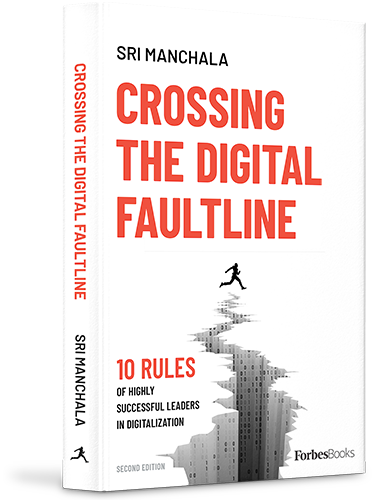
Crossing the Digital Faultline
Comprehensive analysis of the research, patterns, and strategies Digital Champions use to cross successfully.
- Complete 7% vs 93% research findings
- Why transformation outcomes are binary
- Four defining patterns shared by Digital Champions
- Platform strategies delivering compound benefits
- Fortune 500 case studies and transformation playbooks

Experience
CONCIERTO Platform
The unified transformation platform addressing the five forces through AI-powered Services as Software.
- MIGRATE — Multi-cloud adoption with zero-downtime execution
- MODERNIZE — AI-driven application transformation
- MANAGE — Unified operations across AWS, Azure, GCP
- MAXIMIZE — Intelligent cost optimization and FinOps
- INTELLIGENCE — Autonomous intelligence without data migration

Engage and Change the Way you Transform
Customized sessions aligning your strategy with CONCIERTO capabilities.
C-Suite Briefing (60 min)
Platform demonstration showing cloud transformation acceleration from 12+ months to 6-12 weeks, with roadmap scoping and predictable economics.
Technology Leadership Assessment
Application, infrastructure, and data architecture evaluation mapped to MIGRATE, MODERNIZE, and MANAGE capabilities. Deliverable: Platform-accelerated roadmap with validated business cases.
Business Leaders Workshop (Full-day)
Eliminate transformation constraints through accelerated delivery, fixed-cost economics, and multi-cloud freedom. Covers modernization for cloud-native agility and Concierto Intelligence for intelligent data action.
Ready to Transform Your Enterprise?
See how the Concierto Platform can accelerate your transformation journey