





You're not alone—and it's not for lack of trying.
Since Broadcom acquired VMware, you've been running. Running from 150–1,000% licensing increases. Running from 72-core minimums. Running from renewal deadlines with 20% penalties. Your CFO wants answers. Your board wants a "cloud strategy." According to industry research, 74% of your peers are running too.
So you hired consultants. Kicked off an assessment. Built spreadsheets. Three months later, your team is exhausted, your budget is lighter than planned, and your assessment is "almost done."
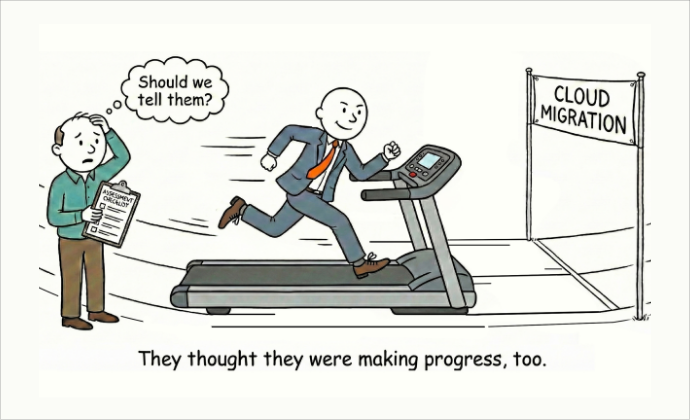
Here's the thing about treadmills: you can run as hard as you want. You're still in the same place—just more tired.
The Real Cost Isn't the Licensing Increase
Yes, Broadcom raised your costs. But that's the obvious pain—the one everyone's talking about.
The hidden cost? Every week your assessment drags on, you pay the old VMware rate while competitors optimize cloud spend. For a 1,000-VM environment, a single month of unnecessary licensing can exceed six figures—just waiting for your assessment to finish.
The treadmill has a price tag. It's just not on the invoice.
Concierto Migration Success
Why Most Assessments Fail
It's not incompetence. It's methodology.
Traditional migrations take 18–24 months. Your VMware renewal won't wait. And here's what nobody tells you about cloud migration assessments: the dangerous ones aren't the ones you skip. They're the ones that take so long your environment changes before you finish. The ones that miss critical dependencies because spreadsheets can't see network traffic. The ones that hand you a 200-page report and leave you guessing which workloads to move first.
Somewhere in your environment—right now—there's a database talking to dozens of systems nobody documented. A storage array that three "decommissioned" applications still depend on. A firewall rule from 2019 that nobody remembers but everything breaks without.
Manual assessments rely on interviews, documentation reviews, and spreadsheets maintained by people who have other jobs. They capture what people remember about the environment—not what the environment looks like. And that one architect who "remembers everything"? Spoiler: they don't. They just remember confidently.
The result? Gaps. Lots of them.
- Dependency blind spots — Manual discovery misses application relationships that only show up in network traffic. You won't know until migration day, when something critical breaks and nobody can explain why.
- Static snapshots — By the time you finish a 3-month assessment, your environment has already changed. New deployments. Decommissioned servers that aren't decommissioned. That "temporary" integration someone built in February that's now load-bearing.
- TCO guesswork — Without automated analysis, cost projections are estimates at best. And estimates tend to be wrong—in the expensive direction.
- Consultant churn — The consultant who started your assessment left in week 3. The new one is "getting up to speed." It's been six weeks.
- Resource drain — Your best people spend months on discovery instead of strategic work. Meanwhile, the backlog grows, the board asks questions, and everyone pretends the timeline is still achievable.
Sound familiar?
The 21 Questions Your Assessment Should Answer
Here's the uncomfortable truth: most assessments don't fail because teams don't work hard enough. They fail because nobody asked the right questions upfront.
Before you migrate a single workload, you need clear answers to 21 critical questions—spanning discovery, dependency mapping, TCO analysis, and migration readiness. Questions like:
- Do you have a complete, current inventory of every VM—including the ones spun up after your last audit?
- Can you map application dependencies that exist in network traffic but never made it into documentation?
- Do you have workload-specific TCO projections across AWS, Azure, and GCP—based on your actual utilization patterns?
- Have you mapped each workload to a 6R strategy with data-driven rationale—not just technical intuition?
- Is your wave plan sequenced by dependency risk, or by the information available at project kick-off?
If you can't answer these confidently, you're still on the treadmill.
Stop Running. Start Moving.
We've compiled the 21 critical questions every VMware migration assessment must answer—the ones that separate successful exits from expensive disasters.
Because running harder won't get you off the treadmill. Stepping off will.
Built for Large-Scale VMware to AWS Migrations
Leading enterprises trust Concierto to migrate thousands of VMware workloads to AWS with predictable outcomes, high reliability, and minimal business impact.















Trianz is an advanced cloud consulting partner with extensive experience managing complex VMware exit programs. Our team of migration specialists can help you determine the fastest, safest path off VMware—and systematically migrate workloads with automated intelligence using CONCIERTO MIGRATE.
Experience the Trianz Difference
Trianz enables digital transformations through effective strategies and excellence in execution. Collaborating with business and technology leaders, we help formulate and execute operational strategies to achieve intended business outcomes by bringing the best of consulting, technology expertise, and execution models.
Powered by knowledge, research, and perspectives, we enable clients to transform their business ecosystems and achieve superior performance by leveraging infrastructure, cloud, analytics, digital, and cybersecurity paradigms. Reach out to get in touch or learn more.